Showing posts with label waves in 1D. Show all posts

Wednesday, September 17, 2008

September 17, 2008

Hello everybody! This is Lynel, and I am today's scribe. Today in class we corrected the the sheets we were given for homework last night. Here are the answers to the worksheets just in case any of you have missed them...

Wave Characteristics

1. a) 330/20000= 0.165m
    b) 330/20= 16.5m

2. λ= 2.9m

3. F= 9.2x10^5 Hz

4. V= (6m)(2Hz)
      = 12m/s

5. a) T= 8s
    b) F= 0.125 Hz 
    c) λ= 16 cm 
    d) V= 2 cm/s

Wave Problems #7-14
Most of these problems invlove drawing so i'll show you where they may be found in the blue booklet.
7. a-d) refer to page 7 in blue booklet
8. a-b) it can also be found on page 7
        c) frequency
d) amplitude
9. Standing waves aren't produced in swimming pools where there are many people present because standing waves require the same wave lengths, amplitude, and frequency.
10. refer to page 7 (G. Wave Interference and the Principle of Superposition)
11. F= 4Hz
      d= 0.3m
      λ= 2(0.3m)
= 6m
     V= Fλ
=(4Hz)(0.6m)
=2.4m/s
12. V= 350m/s
       F= 420Hz
       λ= V/F
 = 350/420
 = 0.83m
The node is 0.83/2 which equals 0.42
  14. a) 3 wavelengths
b) 21 cm
c) 10.5 cm
d) 21m/s

We were also given class time to do the Transparency Worksheet that was handed to us. On this worksheet we learned the properties of two waves, transverse wave and longitudinal waves (compressional). Remember to study for tomorrows test!! Hope everyone does well!!! Tomorrows scribe will be Ryan Rara=) 

Tuesday, September 16, 2008

September 16, 2008 - Tuesday

So hello guys=] It's caaamy (Camy.. in case) and I am your scribe for today, thanks to Yvanne=[. Hah, I'm pretty clueless as to how to use blogger and all, so humor me please.

Today in class, Ms. Kozoriz started off by explaining the two types of wave interference:
Constructive Interference and
Destructive Interference


In case you weren't there or weren't really paying attention, I'll recap for you what you should have picked up from today's lesson.
First of all, wave interference - occurs when two or more waves act simultaneously on the same particles of a medium, resulting in a new displacement.

Constructive Wave Interference
This first type of wave interference occurs when two waves interfere with each other to produce a resultant displacement greater than the displacement that would be caused by either wave.
You can remember this because its title is logical to its concept - construct as in to build, so this is the type of interference that results in a higher amplitude, made up by the two pulses directly on top of each other.

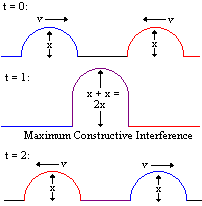
In order to determine the new displacement of the particles, the Principle of Superposition is used. This principle states that the resultant displacement of a given particle is equal to the sum of the displacements that would have been produced by each wave independently. The two pulses can either be a crest and a crest, or a trough and a trough in order for constructive wave interference to happen.
In the example below, let's say that each pulse has an amplitude of 1 cm. As the two pulses approach each other, at the time interval of 1 second, they interfere and are directly on top of each other resulting in the maximum amplitude of 2 cm (the sum of the two waves).


Remember that these two pulses cannot be opposite as in, a crest interacting with a trough, vice versa. That, would result in a different type of wave interference. And you bet that this would be...

Destructive Wave Interference
This type of wave interference occurs when the resultant displacement is smaller (destruction!) than the displacement caused by one wave independently.
The diagram below is much like the one we drew in class today as an example of destructive wave interference. So using it (pulse A is the left pulse, pulse B is the right pulse), the two pulses are approaching each other. They both have an amplitude of 2 cm. At the third time interval, the two pulses are interfering with each other. Because these two pulses are equal in amplitude but opposite to each other, they cancel each other's displacement. This results a displacement of zero, causing the horizontal line that you see.


If you can't get anything out of my explanations then you can check out these sites for further clarification:
Constructive Interference -
http://id.mind.net/~zona/mstm/physics/waves/interference/constructiveInterference/InterferenceExplanation2.html
Destructive Interference -
http://id.mind.net/~zona/mstm/physics/waves/interference/destructiveInterference/InterferenceExplanation3.html
annd hey! Ms. K mentioned this site and it's pretty informative, you should also check it out:
http://www.walter-fendt.de/ph14e/


After our little lesson of today, we were to move on to correcting last night's supposed homework, questions 7-14 from the blue booklet (Grade 11 Physics - Waves in One Dimension). However when Ms. K brought it up and checked to see who finished it, a much less than adequate amount of people completed it.=O. She then gave us the rest of class to work on that, along with the two worksheets, which we must all hand in tomorrow. I should put some emphasis on that.

Homework!!!

- Questions 7-14 from the blue booklet
- The two worksheets to hand in for tomorrow entitled Wave Characteristics and Wave Superposition.
- Study for the Waves in One Dimension Test that will be on Thursday, September the 18th!


Okay, that is all for today's scribe post! I'm sorry if it seems rushed (that's only because it was rushed) AND that it's quite late due to work, but I tried my beeest! And hey, look forward to tomorrow's scribe post which will be done by none other thaaan...
Lynel Pobre! -
lynel (you're very welcome).

See yaahh everyone=]]


Monday, September 15, 2008

Monday, Sept 15 2008

First of all, I am very sorry I just started the blog right now. I just came home from a dance rehersal, I apologize. (: But hey! I'm still in front of my pc doing this awesome blog of mine!
--
Today in class we basically went over the study guide given to us on last friday.

It mostly covered the properties of the waves and the wave interferences.


What I will be doing is picking out certain parts under every subtopic that I believe is the most important out of the whole study guide.


WAVE PROPERTIES

Types Of Waves:

Mechanical waves: require a material medium (basically means it is not capable of transmitting

energy through a vacuum/empty space)

: examples - water waves and sound waves

: 3 kinds of mechanical waves - transverse, longitudinal, and surface waves.


electromagnetic waves: requires no medium

: examples - light waves and radio waves
: produced by the vibrations of charged particles


**refer to past posts by past scribes for further detail on transver, longitudinal and surface waves. **


Refresher on measures of a wave:

frequency: number of complete vibrations per second measured at a fixed location (hertz)

period: shortest time interval in which the motion repeats itself

wavelength: shortest distance between points where the wave pattern repeats itself (lambda)


Amplitude Of a Wave:

- it takes more work to produce a wave with a large amplitude than it does to produce a wave with a small amplitude.

therefore: the larger the amplitude, the more energy is transferred.


WAVE INTERFERENCE:

Waves at Boundaries Between Media:

(media is plural for medium)

this subtopic basically covers what happens to waves when we have more than one medium.


**the speed of a mechanical wave does not depend on the amplitude or the frequency of the wave**

Mrs. Kozoriz said that this is a very important thing we need to know so get it stuck in your head!

**the speed of a mechanical wave does not depend on the amplitude or the frequency of the wave**

Got it yet? Let's just have it one more time.

**the speed of a mechanical wave does NOT depend on the amplitude or the frequency of the wave**


Having that said, the speed of a mechanical wave only depends on the properties of the medium.


incident wave: the wave that reaches the bounday between one medium and another.

transmitted wave: the wave that moves through the new medium

reflected wave: the partial wave of the incident wave that moves backward from the boundary


**when a wave passes from a less dense to a more dense medium, the reflected wave is inverted. **
** when a wave passes from a more dense to a less dense medium, the reflected wave is erect, or on the same side.


!CONSIDER THE FOLLOWING!

When a wave is trasnmitted from one medium to another, the frequency of the wave does not change, however the wavelengthe and the speed of the wave changes.


Superposition of Waves:


PRINCIPLE OF SUPERPOSITION: the displacement of a medium caused by two or more waves is the algebraic sum of the displacements caused by the individual waves.


*interference is the result of the suporposition of two or more waves*

*constructive interference occurs when the wave displacements are in the smae direction.

*destructive interference occuse when the wave displacements are in opposite directions.


Standing Waves:
Node - area that is undisturbed (moves the littlest)
antinode - area with maximum displacement
--
I think that this is a very interesting topic actually. It's my first time to ever study Physics and I'm actually quite interested in this topic. I just find that it has a looot of information you really need to know, like the parts of the waves, what everything does and how it affects other things. Once you really get to understand everything we cover in class, I think the test will be a alright for us all.!
So that's the end of all of this Physics talk.
AAANNNNDDD! not to forget that we have a very lovely Physics Test dedicated to Waves in One Dimension on Thursday, September 18 2008. So study study study!
The scribe for tomorrow will be CAMY TRAN! (caaamy)
ciiiiiaaaaaoo!!
-yvanne gelli dandan (:


Sunday, September 14, 2008

This Isn't A Boring Title.. Not At All

Hello friends, this is Nelsa blogging again (because stupid blogger ERASED EVERYTHING I JUST FINISHED TYPING UP, UGH). .. I'm not mad, no of course not.

So anyways, we went over those three sheets that Ms. Kozoriz gave us how many days ago. I'm not going to bother writing up every single answer because that'd take up a whole bunch of time (again!).

We also corrected the six questions the sub assigned when Ms. K was away. Here are the answers:
1. both - the transverse wave is represented by the vertical component which is made when the dominoes are still standing; the longitudinal wave is represented by the horizontal component created when the dominoes fall
2. .1 cycles/sec - the first wave does not count, there are only ten cycles
3. 520 m
4. 1.7 x10^-5 sec
5. a) 8mm - 'up and down' distance means from crest to crest through a trough
b) 2500 Hz
c).0004 sec ; 125000 cycles
e) 50
6. slower


We were given a 'study guide' at the end of the class, but since we only got five minutes to work on it last class, I'm pretty sure we're going to be working on it on Monday, which is tomorrow.

Okay, that's it. See you all Monday. Oh, yes, and the next scribe shall be Yvanne, cool.

Thursday, September 11, 2008

September 11/08

HEY!!!!!!! It's my turn to scribe today!!! Woo!!! Alright, down to business. Today in class we had the sub who told us to do those questions 1-6 on page 12. I should probably get my sheet so i can write down helpful tips on the blog here. Alright, so, most of the questions involve the motion of waves.

Question 2, you're solving for frequency so its as simple as counting the number of waves and time and plug it into the equation frequency=cycles/second.

Question 3, convert 580 khz into 580000 Hz and divide into the speed of light. The seconds will cancel out leaving you with the answer in meters which is what wavelenght is measured in so presto! you're done that question!

Question 4, convert 2.5 cm into meters. Then substitute into velocity=(frequency)(lambda) solve for frequency since you know wavelength and speed. Then convert your frequency into period by righting out frequency as cycles/second and then inverting it to seconds/cycle.

Question 5, There's a alot of parts to this one, so hang on!

a) It's as simple as multiplying the amplitude of r the wave by 2.
b) Quite simple again, solve for velocity, velocity=(frequency)(lambda), fill lambda and the wave speed and jus solve for frequency

c) Using the frequency from the last question, simply just invert the frequenc from cycles/second to seconds/cycle to get the period

d) This one is a little bit tricky, to start, you need to cross multiply to see how long it takes for the wave to 1km, to do this convert 1km into 1000m, then cross multiply and solve for seconds in the equation of 450m/1sec = 1000m/ ???sec, then using frequency from 2 questions ago, (frequency is cycles per second) multiply your answer for seconds by the frequency and you should be left with an answer with the unit of cycles.

e) And we have already solved this question in the question above.

Question 6, The wave would be slower because if you see on page 7 of the blue booklet, as the pulse hits the higer density medium of the second spring it slows down.

And that is all we did in class on this day of September the 11th, 2008 a.d.

My mother told me to pick the very best scribe and you, are, IT! Nelsa :):)

Live long and prosper everyone!!!!!! :):)

Wednesday, September 10, 2008

September 10, 2008

Hi everyone. Today in class we performed an experiment using "snakeys" also known as slinkies. We followed instructions from the green text book and answered questions on a white sheet. In the experiment we discovered that transverse and longitudinal waves have the same charachteristics. When one person pushes the slinky to the right and another person pushes the slinky to the left then you can see the waves passing through each other.

The next scribe is going to be Dion.

Tuesday, September 9, 2008

September 9, 2008

Archimedes here, replacing Dion as our first scribe after agreeing that he allow me to be the first scribe of our class in exchange for appointing a classmate of his choice to be the next scribe. In case you are wondering who I am, I'm a Greek physicist, mathematician and astronomer. Well, I was at least... or I'm just Aldrin..

Today was a continuation of last Friday where we were ungracefully interrupted by a long, yet brief assembly. We were to obtain a blue "Grade 11 Physics Waves in One Dimension" booklet if we had not already acquired one on Friday. We read the first few pages of the booklet and later proceeded to going on our field or hall trip. We also received four sheets to complete, which are as follows:

Grade 11 Physics: Waves in One Dimension
Physics 11 Period & Frequency Problems
Concept-Development Practice Page: Vibrations and Waves 25-1
Characteristics of Waves: Physics 30S


Here is a general overview of what we discussed and did in class.

Archimedes’ Language Bank (Terms and Definitions)


Key Formulas
V= λ / T
V=f λ
F=1/T


Continuous (Periodic) Wave: a wave produced by a disturbance (oscillating or vibrating source) that is moving back and forth continuously
-Producing a back and forth motion while holding onto a slinky creates a continuous wave

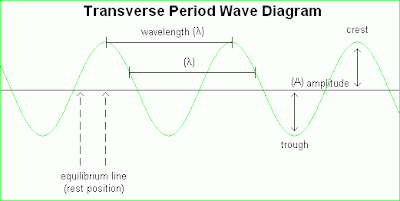
Transverse Wave: a continuous occurrence of pulses where the particles are simply displaced up and down while traveling in a direction that is perpendicular to the pulse itself
-Waves traveling on a guitar

Crest: the highest point on a wave

Trough: the lowest point on a wave

Amplitude (A): the distance between a crest or trough and equilibrium lin

Equilibrium Line (Level): the undisturbed position or axis of zero

Cycle: one complete sine wave or complete up and down motion, which is also known as one complete oscillation

Wavelength (λ): horizontal length of one cycle of a wave, or in other words, the horizontal distance between any two successive equivalent points on the wave. In a longitudinal wave, it is the horizontal distance between the center of a rarefaction and center of one next to it

Frequency (f): number of complete cycles or crests that pass a given point per unit of time, commonly measured in cycles per second or hertz (Hz)

Period (T): the time elapsed between two successive crests passing by the same point in space where the standard unit of period is the second

Wave Velocity (V): velocity at which the wave moves

Longitudinal Wave: the vibration of particles of the medium traveling the same direction as the motion of the wave

Compressions: areas in a longitudinal wave that are momentarily close together

Rarefactions (Expansions): regions where the coils are momentarily far apart

I apologize for my lack of effort I put into this scribe post. You may find a lot of grammatical, capitalization, punctuation, and spelling errors, but whatever. I needed to rush because I had other things to do. Anyways, good luck to the next scribe, who is Rebecca and slinky thingy tomorrow I believe?