hi everyone!!! it's me, LORENZ!!! i guess this will be my last post for our class. Yesterday, we had a sub and she gave us a booklet 2.3 Ferromagnetism and the Domain Theory of Magnetism. She gave us time to read through it and then she told us to answer those 4 questions on 2.9 Exercise located at the back of the last page. Here are the answers that i got:
1) When magnetizing a steel nail, you must stroke it against a permanent magnet and heat or drop the magnet to lose the magnetization.
2) No, because aluminum can't be magnetize, must be made of a ferromagnetic material.
3) Real magnet can be repelled or attracted to either end, and ferromagnetic can stick on both ends.
4) It will not reflect solar radar from the sun.
After we finish correcting those 4 questions, she gave us some notes about Right Hand Rule. I am sorry but i did not copy those notes because it is already in our Chapter 24 Study Guide but i hope that everyone is now preparing for our upcoming final exam on Monday, January 26, 2009 in the school Gym at 1pm.
Like what nelsa said, everyone is been trying to finish their blog so i hope that everyone will get to finish theirs. So to continue this, i choose Lynel Pobre to do the next blog since she didn't get to do hers last time because of her other homework.
I'll see you guys on Monday!!=)
Showing posts with label scribe. Show all posts
Showing posts with label scribe. Show all posts
Saturday, January 17, 2009


Thursday, January 15, 2009
Study Guide..
Hello, hello friends! Yeah, I know I'm not Lorenz, I'm prettier. Just kidding! It's funny how ever since Ms. K told us that we had to have at least 3 scribe posts, everyone's been scrambling to get their last one done, hahaha.
Now down to business.
We had a sub today, Mr. Neufeld I believe was his name. He was pretty cool, he gave us a sudoku to do in the beginning of class and like.. three people finished it after 3 minutes.. or something like that. Hahaha, so then we stopped and did the actual work.
We finished (hopefully) our Chapter 24 Study Guide and corrected only the first two paragraphs because we ran out of time. Mm, so I guess I'll give you the list of words, in case you decided to skip today's class (shame, shame).
GENERAL PROPERTIES OF MAGNETS
01. pole
02. north
03. south
04. attract
05. repel
06. temporary
07. polarization
08. permanent
MAGNETIC FIELDS AROUND PERMANENT MAGNETS
01. touch
02. distance
03. magnetic field
04. magnet
05. tangent
06. strength
07. magnetic flux
08. flux
09. strength
10. poles
11. north
12. loops
13. unlike
14. force
15. aligned
16. concentrated
17. s-pole
18. attracts
19. repels
20. magnetic flux
21. lose
Yeaahh.. so that was today's class. See you all tomorrow!
Next scribe will be Lorenz, because he was supposed to be today's scribe. =)
Now down to business.
We had a sub today, Mr. Neufeld I believe was his name. He was pretty cool, he gave us a sudoku to do in the beginning of class and like.. three people finished it after 3 minutes.. or something like that. Hahaha, so then we stopped and did the actual work.
We finished (hopefully) our Chapter 24 Study Guide and corrected only the first two paragraphs because we ran out of time. Mm, so I guess I'll give you the list of words, in case you decided to skip today's class (shame, shame).
GENERAL PROPERTIES OF MAGNETS
01. pole
02. north
03. south
04. attract
05. repel
06. temporary
07. polarization
08. permanent
MAGNETIC FIELDS AROUND PERMANENT MAGNETS
01. touch
02. distance
03. magnetic field
04. magnet
05. tangent
06. strength
07. magnetic flux
08. flux
09. strength
10. poles
11. north
12. loops
13. unlike
14. force
15. aligned
16. concentrated
17. s-pole
18. attracts
19. repels
20. magnetic flux
21. lose
Yeaahh.. so that was today's class. See you all tomorrow!
Next scribe will be Lorenz, because he was supposed to be today's scribe. =)
Wednesday, January 14, 2009
January 14 2009 - YVANNE
Hey guys!
So I know I'm not Lynel Pobre, but she asked me if I can possibly do the scribe for her instead because she's stuck doing a thousand word essay due to procrastination! Good luck to her .
Anyways, there's really not much that we did today. Our whole class was dedicated to writing our Electric and Magnetic Fields test. I guess I'm just here for a couple of reminders and such.
Mrs. K handed out a couple of sheets for Magnetism. We should probably read through the booklet so we have an idea of what this unit will be about. There's also a Study Guide for Magnetism if you guys wanted to start on that (although the answers are in the green book, you can probably find them elsewhere!)
Do not forget our exam date!
Physics 30S Exam: January 26 2009 Monday
I think this is a great time to start looking through everything we've learned so that we do not end up scrambling at crunch time!
going going ... GONE!
ohh the scribe for tomorrow will be.. LORENZ BRUCAL cause he wants extra marks.
buahah . (:
-ydandan
So I know I'm not Lynel Pobre, but she asked me if I can possibly do the scribe for her instead because she's stuck doing a thousand word essay due to procrastination! Good luck to her .
Anyways, there's really not much that we did today. Our whole class was dedicated to writing our Electric and Magnetic Fields test. I guess I'm just here for a couple of reminders and such.
Mrs. K handed out a couple of sheets for Magnetism. We should probably read through the booklet so we have an idea of what this unit will be about. There's also a Study Guide for Magnetism if you guys wanted to start on that (although the answers are in the green book, you can probably find them elsewhere!)
Do not forget our exam date!
Physics 30S Exam: January 26 2009 Monday
I think this is a great time to start looking through everything we've learned so that we do not end up scrambling at crunch time!
going going ... GONE!
ohh the scribe for tomorrow will be.. LORENZ BRUCAL cause he wants extra marks.
buahah . (:
-ydandan
Tuesday, January 13, 2009
January 13, 2009
Hello everybody. This shall possibly be my last official scribe post for this blog. In addition, today is a big day. It is the day that marks the intervention of having a one month anniversary of blogging absences for this blog. It is also the day that precedes our Gravitational-Electric Fields Test. Good luck to everyone on that. As for what happened today in class, we went through a couple of worksheets and problems. Here is a concise summation of the essential bits gone through below.
We wholly went through Gravitation Fields Review - Worksheet. There exists three sample questions with answers at the very bottom of the last page. Be sure to check that out.
We went through Chapter 2: Motion - Exercise 2-1. Answers are as follows:
1. Greyhound speed=16m/s, Gazelle time=0.01s, and Turtle distance=30cm.
2. a) The BB is gaining distance and speed in each successive time interval.
b) Yes, distance is directly proportional to T^2 (time squared)
c) Distance Fallen: 1, 4, 9
d) Yes; 9cm, 11cm, 13cm. Distance Fallen: 1, 3, 5, 7
e) odd
3. a) 10, acceleration
b) time
c) 70m/s, 245, 10
Green Textbook Questions *forgot pages*
1) 20000 N/C
2) 7 x 10^-5 C
3) 4.44 x 10^-7 C
17. a) 1.6 x 10^-18 C
b) N = 10 electrons
In pre-conclusion, we received Chapter 24: Study Guide - 24.1 Magnets: Permanent and Temporary, The Earth's Magnetic Field, and 1.3 Magnetic Poles worksheets. Oh yeah, people need to scribe. I initially was just going to let the next scribe be anyone that needed to scribe, but seeing as how I took initiative after so many days, I shall choose a person so that they are obligated to scribe. Well hopefully they commit. Hmm. Roses are red, violets are blue, no available scribe name rhymes with blue, so Lynel I choose you :P
We wholly went through Gravitation Fields Review - Worksheet. There exists three sample questions with answers at the very bottom of the last page. Be sure to check that out.
We went through Chapter 2: Motion - Exercise 2-1. Answers are as follows:
1. Greyhound speed=16m/s, Gazelle time=0.01s, and Turtle distance=30cm.
2. a) The BB is gaining distance and speed in each successive time interval.
b) Yes, distance is directly proportional to T^2 (time squared)
c) Distance Fallen: 1, 4, 9
d) Yes; 9cm, 11cm, 13cm. Distance Fallen: 1, 3, 5, 7
e) odd
3. a) 10, acceleration
b) time
c) 70m/s, 245, 10
Green Textbook Questions *forgot pages*
1) 20000 N/C
2) 7 x 10^-5 C
3) 4.44 x 10^-7 C
17. a) 1.6 x 10^-18 C
b) N = 10 electrons
In pre-conclusion, we received Chapter 24: Study Guide - 24.1 Magnets: Permanent and Temporary, The Earth's Magnetic Field, and 1.3 Magnetic Poles worksheets. Oh yeah, people need to scribe. I initially was just going to let the next scribe be anyone that needed to scribe, but seeing as how I took initiative after so many days, I shall choose a person so that they are obligated to scribe. Well hopefully they commit. Hmm. Roses are red, violets are blue, no available scribe name rhymes with blue, so Lynel I choose you :P
Wednesday, December 17, 2008
December 17, 2008
Hello everybody! This is Alex :) I am scribing today, so lets get started.
Today was a work period so there isn't a lot to say. We had to finish our lab report, once we did that we were required to read page 8 of the white booklet Ms. Kozoriz (sorry if I spelled that wrong) gave us. Once we did that we had to do 4 worksheets. Sorry I don't have a scanner so I can't scan them onto this blog, however they were fairly easy just remember Newton's second law (a=Fnet/m) and Fnet= Fg + Fn. Fg= (m)*(g).
So that was basically it. I hope everyone has a wonderful Holiday and stays warm, see you tomorrow.
For the next post I don't know how the choosing process works so....... um how about Mark. Ms. Kozoriz can change it if she wants.
Today was a work period so there isn't a lot to say. We had to finish our lab report, once we did that we were required to read page 8 of the white booklet Ms. Kozoriz (sorry if I spelled that wrong) gave us. Once we did that we had to do 4 worksheets. Sorry I don't have a scanner so I can't scan them onto this blog, however they were fairly easy just remember Newton's second law (a=Fnet/m) and Fnet= Fg + Fn. Fg= (m)*(g).
So that was basically it. I hope everyone has a wonderful Holiday and stays warm, see you tomorrow.
For the next post I don't know how the choosing process works so....... um how about Mark. Ms. Kozoriz can change it if she wants.
Tuesday, December 16/08
Sorry for the late post, for thsoe who check this blog regularly, I kinda forgot and just remebered this morning. Well Yesterday we didnt do much. We learned about the weight and scale and how it REALLY feels when you move it up or down. We were also given a Lab to do which is probably due today if anyone is unsure.
Heres the notes she gave us, please make sure to correct me if I'm wrong because I'm writing this based on memory.Also sorry that I can't post any diagrams to explain this better.
F=mg
At this point the weight is at rest so it will feel normal.
F=mg + ma
You move the weight and scale along with it up and this is how it will feel...
It will become heavier at first then at a constant velocity you will feel normal. Then as you start to slow down as you reach the end the weight then becomes lighter.
F=mg -ma
This one is opposite direction with the opposite affect. You feel light at first as you move the weight and scale in the downward direction, then at constant velocity it feels normal. When you the start to slow down towards the end it will then become heavy.
*NOTE* When I say it feels normal it just means you can't tell if it got heavier or lighter then before.
The Lab...
For those who were confused on what they needed to do
What we had to do was get a rubber thingy(don't rember what its called) and tie to to a piece of string that is about 1.5 m's long. You then shorten the string by rolling in your hand to get 1.2m, 1.0m, 0.8m, 0.6m, 0.4m ,0.2m. These are the different lengths that you will be measuring how much time its takes for it to swing twenty cycles( one cycle equals the time it takes for it to come back from where you started it. Remember to start the rubber stopper up to the right of you and keep hand still will doing experiment. Its quite annoying to hold all the time so switch places with your partner if your arm feel tired. Record all the data 3 times each. Then average your time. The period is calculated by the (average time/20 cycles it did). Of course do the Analysis questions after you have completed this experiment and dont forget to hand in.
Sorry once again for the late post as I COMPLETELY FORGOT even though I was told before hand. :S
The next scribe I choose will be Alex Sharp. So good luck Alex with next scribe.
Heres the notes she gave us, please make sure to correct me if I'm wrong because I'm writing this based on memory.Also sorry that I can't post any diagrams to explain this better.
F=mg
At this point the weight is at rest so it will feel normal.
F=mg + ma
You move the weight and scale along with it up and this is how it will feel...
It will become heavier at first then at a constant velocity you will feel normal. Then as you start to slow down as you reach the end the weight then becomes lighter.
F=mg -ma
This one is opposite direction with the opposite affect. You feel light at first as you move the weight and scale in the downward direction, then at constant velocity it feels normal. When you the start to slow down towards the end it will then become heavy.
*NOTE* When I say it feels normal it just means you can't tell if it got heavier or lighter then before.
The Lab...
For those who were confused on what they needed to do
What we had to do was get a rubber thingy(don't rember what its called) and tie to to a piece of string that is about 1.5 m's long. You then shorten the string by rolling in your hand to get 1.2m, 1.0m, 0.8m, 0.6m, 0.4m ,0.2m. These are the different lengths that you will be measuring how much time its takes for it to swing twenty cycles( one cycle equals the time it takes for it to come back from where you started it. Remember to start the rubber stopper up to the right of you and keep hand still will doing experiment. Its quite annoying to hold all the time so switch places with your partner if your arm feel tired. Record all the data 3 times each. Then average your time. The period is calculated by the (average time/20 cycles it did). Of course do the Analysis questions after you have completed this experiment and dont forget to hand in.
Sorry once again for the late post as I COMPLETELY FORGOT even though I was told before hand. :S
The next scribe I choose will be Alex Sharp. So good luck Alex with next scribe.
Monday, December 15, 2008
Howdy Fellow Bloggers!
Today we didn't do much of anything that is new.
What we did was work more on the lab worksheet we were given on December 12, aka Friday. I believe that is due tomorrow, but that is just an assumption.
We were also given the answers for "Concept-Development Practice Page 13-1 -- Chapter 13: Gravitational Interactions", so here they are:
1. An apple that has a mass of 0.1kg has the same mass wherever it is. The amount of matter that makes up the apple
DOES NOT DEPEND UPON
the location of the apple. It has the same resistance to acceleration wherever it is -- its inertia everywhere is
THE SAME.
The weight of the apple is a different story. It may weigh exactly 1N in San Fransisco and slightly less in mile high Denver, Colorado. On the surface of the moon the apple would weigh 1/6N, and far out in outer space it may have almost no weight at all. The quantity that doesn't change with location is
MASS,
and the quantity that may change with location is its
WEIGHT.
That's because
WEIGHT
is the fore due to gravity on a body, and this force caries with distance. So weight is the force of gravity between two bodies, usually some small object in contact with the earth. When we refer to the
WEIGHT
of an object we are usually speaking of the gravitational force that attracts it to the earth.
2. If we stand on a weighing scale and find that we are pulled toward the earth with a force of 500N, the we weight 500N. Strictly speaking, we weight 500N relative tot he earth. How much does the earth weight? If we tip the scale upside down and repeat the weighing process, we can say that we and the earth are still pulled together with a force of 500N, and therefore, relative to us, the whole 6 000 000 000 000 000 000 000 000-kg earth weighs 500N! Weight, unlike mass, is a relative quantity.
Hmm, that seems to be it.
OH, also, if you are bored read pages 5 and 6 for tomorrows class in the Dynamics booklet. And tomorrow we have another lab, so don't miss it!
The scribe for tomorrow shall be... Anthony L!
Toodles!
What we did was work more on the lab worksheet we were given on December 12, aka Friday. I believe that is due tomorrow, but that is just an assumption.
We were also given the answers for "Concept-Development Practice Page 13-1 -- Chapter 13: Gravitational Interactions", so here they are:
1. An apple that has a mass of 0.1kg has the same mass wherever it is. The amount of matter that makes up the apple
DOES NOT DEPEND UPON
the location of the apple. It has the same resistance to acceleration wherever it is -- its inertia everywhere is
THE SAME.
The weight of the apple is a different story. It may weigh exactly 1N in San Fransisco and slightly less in mile high Denver, Colorado. On the surface of the moon the apple would weigh 1/6N, and far out in outer space it may have almost no weight at all. The quantity that doesn't change with location is
MASS,
and the quantity that may change with location is its
WEIGHT.
That's because
WEIGHT
is the fore due to gravity on a body, and this force caries with distance. So weight is the force of gravity between two bodies, usually some small object in contact with the earth. When we refer to the
WEIGHT
of an object we are usually speaking of the gravitational force that attracts it to the earth.
2. If we stand on a weighing scale and find that we are pulled toward the earth with a force of 500N, the we weight 500N. Strictly speaking, we weight 500N relative tot he earth. How much does the earth weight? If we tip the scale upside down and repeat the weighing process, we can say that we and the earth are still pulled together with a force of 500N, and therefore, relative to us, the whole 6 000 000 000 000 000 000 000 000-kg earth weighs 500N! Weight, unlike mass, is a relative quantity.
Hmm, that seems to be it.
OH, also, if you are bored read pages 5 and 6 for tomorrows class in the Dynamics booklet. And tomorrow we have another lab, so don't miss it!
The scribe for tomorrow shall be... Anthony L!
Toodles!
Friday, December 12, 2008
Dec 12 blog
Hey everyone!

Well today in class we got our Newton's Laws of Motions test back, and Ms.K went over the answers for it. So here are the answers:
1. gravitational, electromagnetic, strong nuclear, weak nuclear
2. The coin will land at your feet because it has the same velocity as the bus.
3. The net force would equal zero.
4. Normal force, gravitational force.
5. 75 N
6. It shows the forces acting on an object.
7.
8 a) acceleration will double
br) acceleration will double
c) 1/8 the acceleration
9.a) 4.oN [S]
b)7.8 [at 40° north of east]
10. a=Fnet/m
= 9.50N[S]/20.0Kg
= 0.475m/s² [S]
b) V=(A)(t)
=(o.475m/s²)(1.86s)
= 0.884m/s[S]
11. a=Fnet/m
= 3.2N[E]/ 6.0Kg
= o.533m/s²[E]
12. a=V/t Fnet=(a)(m)
=8.0m/s /1.5s =(5.33m/s²)(110Kg)
= 5.33m/s² = 586N
13.a) b)


After correctin our test we read through the booklet on Gravitational Fields. Then we got 2 sheets, The Elevator Ride and Force and Weight Concept Development. We worked on the Elevator Ride lab for the rest of the class and we will finish it up on monday.
Have a good weekend!! The next scribe will be Nicole. : )
Good Morning bloggers
well its a new beautiful day today! well in class yesterday, thursday the 11th, (sorry about my spelling and what not) we had our dynamics test!! woot! it was pretty simple test and i don't know what else to say. O ya! Ms.K gave us that new booklet of notes that we should read before today's class. I think that's all we did? test and the new book for the new unit? ya?alrity then cya all in class!! next scribe is rebecca.
Wednesday, December 10, 2008
Class on Wednesday, December 10, 2008
I'll revive this fairly deceased blog by re-initiating scribing. *cough* bonus marks *cough* I mean there is a test tomorrow on the unit, dynamics - a branch of mechanics that deals with forces and their relations to patterns of motion. I posted the sheet consisting of anagrams because it was from the past and no one was blogging for quite a while. Okay, so euphemistically, there is a lovely and highly admired test tomorrow. Good luck to everyone. There is an immaculate review below as posted by our teacher to remedy any difficulties that one may stumble upon while writing the test. Below are sheets I scanned, so feel free to browse.


remember that there is no air resistance when a rock is in free fall. that was my first instinct but then i asked for the opinions of others


for 8b) Ms. K said the answer being force RESISTING the car's motion was 3740N, but I still object. The force of the car caused by acceleration is 3740N as calculated by multiplying the mass and acceleration. To further justify, it states that the force put on the wheels due to the road is 5600N, which is a frictional force and what we are trying to find is the resisting force being the force impeding the car. So I obtain the difference between the two resultant forces which results in 1860 N [East]. Friction resists, so this is the resisting force.

We went through the sheets above and received back our assignment on vectors. Well this is a fairly accurate summation of class today. I dub the next scribe Sir Dion Palumbo. He's a lucky duck to be the scribe for the day of the test. Thou shall scribe effortlessly because of the sympathetic initiator.
Thursday, December 4, 2008
Force And Acceleration Lab
Hi there!
Sorry I forgot to blog yesterday.
Anyway, here's the lab that we did yesterday and today:
First of all we should know the Newton's laws;
First Law - When no net external force is acting on an object, it will either remain at rest or if it is moving, it will continue to move in a straight line at a constant speed.
Second Law - If an unbalanced force acts on an object, the object will undergo an acceleration directly proportional to the magnitude of the force.
Equipment:
Recording Timer
Washers
Lab Cart
Paper clips
Carbon Paper Discs
Pulley
Long Flat board/surface
Timer Tape
String
50 g
100 g
200 g
Procedure:
1. Load the cart with the weights (50, 100 and 200 grams). Attaach one end of the string to the cart. Tie a paper clip to the other end of the string and pass it over the pulley. Hang the metal washers on the clip until the friction force acting on the cart is just offset. Forces due to friction are offset when you can give the cart a very slight push and it moves at a constant speed across the table. Do no removethe added weight at any time.
2. Pull the end of the timer tape through the timer and attach it to and end part of the cart. For the first trial, reemov the 50 g mass from the cart and hang it on the end of the string.
3. Star the timer and release the cart. Stop the timer and the cart when the cart reaches the pulley. Renove the timer tape and label it "50 g trial" on the end that was attached to the cart.
4. Remove the 50 g mass from the string and put it back on the cart. Remove the 100 g mass from the cart and place it on the end of the string. Make and label a second tape in the same way as you made the first tape.
5. Repeat steps 2 and 3 for 150 g, 200 g, and 250 g.(as a result increasing the mass by 50 g each time.) Be sure to place each mass on the cart after using it.
6. In this investigation, wour cart will in general undergo less acceleration than did those of prior investigations. For this reason, it is best to use a larger time interval than thoose used in earlier investigations. Label the first dot on each tape zero. Label every ffith dot after that 1, 2, 3, 4 and so on. The distance between two each numbered dots represents one time interval (a "tock"). The distance between each numbered dot is numerically the same as the avaerage velocity for each time interval. The distance is also numerically the same as the instantaneous velocity for the midpoint of the time interval. Measure each distance on each tape carefully and record al your values.
Interpretation:
1. On the same graph, make a velocity versus time plot for each tape. Plot veloccity on the vertical axis anad the time interval on the horizontal axis.
2. The slope of a velocity time graph is (Vf - Vi)/t, which is the acceleration. Determine the slope of each of the lines on your velocity-time(tock) graph. Record each value.
3. Plot a graph of acceleration versus force with force on the horizontal axis.
4. Explain the meaning of the graph. Does it substantiate Newton's second law?
The next blogger is Thoa:-)
Sorry I forgot to blog yesterday.
Anyway, here's the lab that we did yesterday and today:
First of all we should know the Newton's laws;
First Law - When no net external force is acting on an object, it will either remain at rest or if it is moving, it will continue to move in a straight line at a constant speed.
Second Law - If an unbalanced force acts on an object, the object will undergo an acceleration directly proportional to the magnitude of the force.
Equipment:
Recording Timer
Washers
Lab Cart
Paper clips
Carbon Paper Discs
Pulley
Long Flat board/surface
Timer Tape
String
50 g
100 g
200 g
Procedure:
1. Load the cart with the weights (50, 100 and 200 grams). Attaach one end of the string to the cart. Tie a paper clip to the other end of the string and pass it over the pulley. Hang the metal washers on the clip until the friction force acting on the cart is just offset. Forces due to friction are offset when you can give the cart a very slight push and it moves at a constant speed across the table. Do no removethe added weight at any time.
2. Pull the end of the timer tape through the timer and attach it to and end part of the cart. For the first trial, reemov the 50 g mass from the cart and hang it on the end of the string.
3. Star the timer and release the cart. Stop the timer and the cart when the cart reaches the pulley. Renove the timer tape and label it "50 g trial" on the end that was attached to the cart.
4. Remove the 50 g mass from the string and put it back on the cart. Remove the 100 g mass from the cart and place it on the end of the string. Make and label a second tape in the same way as you made the first tape.
5. Repeat steps 2 and 3 for 150 g, 200 g, and 250 g.(as a result increasing the mass by 50 g each time.) Be sure to place each mass on the cart after using it.
6. In this investigation, wour cart will in general undergo less acceleration than did those of prior investigations. For this reason, it is best to use a larger time interval than thoose used in earlier investigations. Label the first dot on each tape zero. Label every ffith dot after that 1, 2, 3, 4 and so on. The distance between two each numbered dots represents one time interval (a "tock"). The distance between each numbered dot is numerically the same as the avaerage velocity for each time interval. The distance is also numerically the same as the instantaneous velocity for the midpoint of the time interval. Measure each distance on each tape carefully and record al your values.
Interpretation:
1. On the same graph, make a velocity versus time plot for each tape. Plot veloccity on the vertical axis anad the time interval on the horizontal axis.
2. The slope of a velocity time graph is (Vf - Vi)/t, which is the acceleration. Determine the slope of each of the lines on your velocity-time(tock) graph. Record each value.
3. Plot a graph of acceleration versus force with force on the horizontal axis.
4. Explain the meaning of the graph. Does it substantiate Newton's second law?
The next blogger is Thoa:-)
Tuesday, December 2, 2008
Video mr.same same
Hi! Everyone...it's me Larlyn014 your scribe for today's class...
Today!
We watch a video of mr. same same..I think that's what they call him....anyways...it's about Inertia force.
INERTIA FORCE
Today!
We watch a video of mr. same same..I think that's what they call him....anyways...it's about Inertia force.
INERTIA FORCE
- Inertia in other words mass
- Mass in other words Matter
Note: If you have an arrow with a bow then shot it. What's keeping the arrow moving? There's no any things that keeping it moving Inertia that make who make it move by itself.
Sorry that's the only I remember on what we just watch. And I remember there's another example he shows to prove things more clearly.
After watching that Mrs. Kozoris let us finished the worksheet she gave from yesterdays class.That's all for today.
Im really sorry I didn't explain things more clearly. I was trying to find video to clear things up and this is what I found
Here's another one.....example of Newton's First Law
THE INERTIA
Next scribe Intrepid ^_^
Monday, December 1, 2008
hello!!
Hello!! It's me Ramina Lyn..
today in class, we corrected the test, then we started the new lesson "Dynamics". Also we got 4 sheets about dynamic from Ms. k...
here's the correction...
1. Vector quantities
- position
- force
- displacement
- acceleration
- velocity
2. Measure initial and final velocities (add them) and then divide by two or Calculate total displacement divided by time.
3. constant (uniform)
4. a) 650 km
b) 150 km [E]
5. a) 108 km/h
b) 25 km/h [E] ---> 30 km/h [E]
6. a) +10 m
b) 0m
c) -40 m
d) 0m
7. a) +2m/s
b) 0m/s
8. a) Car moving at a constant (uniform) velocity of 0m/s
b) cars slowing down
c) 0m/s
d) -5 m/s2
9. +180 m/s
10. --> start a distance away from motion sensor , stand still
------> walk at a constant speed towards motion sensor and then past it
------> stand still
11. 5.0 m/s2
12. 1120 m
13. 28 m
14. 916. 67 m/h or 920 m/h
We also read the Four Fundamental Forces..
The four fundamental forces are: gravitational, electromagnetic, strong nuclear, and weak nuclear force.
Gravitational Force - an attraction between two objects because of their mass. It is the weakest of the foue force. Range is unlimited and attractive.Also the least selective because it acts between all particles.
Electromagnetic Force - the force that charged particles exert on each other. It binds together the atoms and molecules that make up the matter that we see around us. It can be either attractive or repulsive. It is much stronger than the gravitational force and its range is also unlimited.
Strong Nuclear Force - an attractive force that holds protons and neutrons in the nucleus of an atom. It is the strongest of the four force, but only acts over small distances.
Weak Nuclear Force - million times fainter than strong force and hundred times shorter in range. Much stronger than the gravitational force. It is involved in the radioactive decay of some nuclei. It has been linked with the electromagnetic force.
ok that's all we did today =)
the next scribe is larlyn...
today in class, we corrected the test, then we started the new lesson "Dynamics". Also we got 4 sheets about dynamic from Ms. k...
here's the correction...
1. Vector quantities
- position
- force
- displacement
- acceleration
- velocity
2. Measure initial and final velocities (add them) and then divide by two or Calculate total displacement divided by time.
3. constant (uniform)
4. a) 650 km
b) 150 km [E]
5. a) 108 km/h
b) 25 km/h [E] ---> 30 km/h [E]
6. a) +10 m
b) 0m
c) -40 m
d) 0m
7. a) +2m/s
b) 0m/s
8. a) Car moving at a constant (uniform) velocity of 0m/s
b) cars slowing down
c) 0m/s
d) -5 m/s2
9. +180 m/s
10. --> start a distance away from motion sensor , stand still
------> walk at a constant speed towards motion sensor and then past it
------> stand still
11. 5.0 m/s2
12. 1120 m
13. 28 m
14. 916. 67 m/h or 920 m/h
We also read the Four Fundamental Forces..
The four fundamental forces are: gravitational, electromagnetic, strong nuclear, and weak nuclear force.
Gravitational Force - an attraction between two objects because of their mass. It is the weakest of the foue force. Range is unlimited and attractive.Also the least selective because it acts between all particles.
Electromagnetic Force - the force that charged particles exert on each other. It binds together the atoms and molecules that make up the matter that we see around us. It can be either attractive or repulsive. It is much stronger than the gravitational force and its range is also unlimited.
Strong Nuclear Force - an attractive force that holds protons and neutrons in the nucleus of an atom. It is the strongest of the four force, but only acts over small distances.
Weak Nuclear Force - million times fainter than strong force and hundred times shorter in range. Much stronger than the gravitational force. It is involved in the radioactive decay of some nuclei. It has been linked with the electromagnetic force.
ok that's all we did today =)
the next scribe is larlyn...
Thursday, November 27, 2008
Kinematics Test
Nimen Hao!!!!! (Hi, y'all.)
We had a test today; our test was all about average velocity, acceleration, position-time graph, velocity time graph…etc.oh…it’s out of 40…. i think that's what we all did for today’s class…
We have a new topic ….I’m not sure if it is Dynamic…I found some websites about dynamics …but I’m not sure if they’re related to our new lesson on Monday…..
http://www.euclideanspace.com/physics/dynamics/index.htm
http://regentsprep.org/Regents/physics/phys-topic.cfm?Course=PHYS&TopicCode=01c
JIAYOU!!!!!!!!!(Do ur best)
We had a test today; our test was all about average velocity, acceleration, position-time graph, velocity time graph…etc.oh…it’s out of 40…. i think that's what we all did for today’s class…
We have a new topic ….I’m not sure if it is Dynamic…I found some websites about dynamics …but I’m not sure if they’re related to our new lesson on Monday…..
http://www.euclideanspace.com/physics/dynamics/index.htm
http://regentsprep.org/Regents/physics/phys-topic.cfm?Course=PHYS&TopicCode=01c
JIAYOU!!!!!!!!!(Do ur best)
Wednesday, November 26, 2008
Hi guys, it's Suzette. Today, we corrected worksheets.
1. Information in Kinematics Graphs
2. Acceleration Motion I
3. Simple Vectors
Answers: Information in Kinematics Graphs

Answers: Accelerated Motion I
1. a. 15 m/s
b. 18.75 m
2. a. 200 m/s
b. 912.5 m
3. a. 1.5 m/s/s
b. 120 m
4. 250 m
5. 11 m/s/s
Answers: Simple Vectors
1. distance - s
mass - s
time - s
area - s
force - v
displacement - v
velocity - v
acceleration - v
2.

3. a. d= 800 m
b. d= 583
angle = 50 degrees
4. a. f = 200 N
b. f = 0 N
c. f = 1414 N
Then after correcting all those sheets, we did an exercise from the book.
Problem - p. 82 -83, # 1, 5, 8, 10, 11, 16
answers:
1. a = 8.0 m/s/s
5. v2 = 33 m/s
8. a. v2 = 607 m/s
b. N = a. 1.83
10. d = 920 m
11. d = 1700 m
16. v2 = 7 m/s
NEXT SCRIBE IS KIMBERLY!
1. Information in Kinematics Graphs
2. Acceleration Motion I
3. Simple Vectors
Answers: Information in Kinematics Graphs

Answers: Accelerated Motion I
1. a. 15 m/s
b. 18.75 m
2. a. 200 m/s
b. 912.5 m
3. a. 1.5 m/s/s
b. 120 m
4. 250 m
5. 11 m/s/s
Answers: Simple Vectors
1. distance - s
mass - s
time - s
area - s
force - v
displacement - v
velocity - v
acceleration - v
2.

3. a. d= 800 m
b. d= 583
angle = 50 degrees
4. a. f = 200 N
b. f = 0 N
c. f = 1414 N
Then after correcting all those sheets, we did an exercise from the book.
Problem - p. 82 -83, # 1, 5, 8, 10, 11, 16
answers:
1. a = 8.0 m/s/s
5. v2 = 33 m/s
8. a. v2 = 607 m/s
b. N = a. 1.83
10. d = 920 m
11. d = 1700 m
16. v2 = 7 m/s
NEXT SCRIBE IS KIMBERLY!
Tuesday, November 25, 2008
Monday & Tuesday, November 24-25,2008
Today I'll be doing two blogs since I forgot to do it for monday and assign someone for Tuesday. First we corrected alot of sheets in physics, "Components of vectors", first page of Acceleration, 4.1 What is acceleration?
Components of vectors
1. b
2. b
3. c
4. b
5. d
6. a
7. c
8. c
9. b
10. c
11. c
12. c
13. c
14. c
Acceleration (first page)
1. a = V2-V1/Change of time = 25m/s-0m/s / 4s-0s = 6.3 m/s²
2. a = V2-V1/change of time = 29.28m/s-0m/s / 3s-0s = 9.8 m/s²
3. V2 = V1 + a(change of time) = 28m/s + (2.5m/s²)(3s-0s) = 36m/s
4. change of time = V2-V1 / a = 14.1m/s -0m/s / 13.2m/s² = 4.4s
5. change of velocity = a(change of time) = 56.3m/s²(1.9) = 107m/s = 110m/s with sig. digits
What is Acceleration?
The change in velocity divided by the time interval is average acceleration. It can be calculated using the equation a=v/t. In this equation a stands for acceleration, ٨V stands for change in velocity, and ٨t stands forthe time interval. If velocity is measured in metres per second, acceleration is measures in m/s/s, which is read as metres per second per second. The unit also can be written as m/s², which is read as metres per second squared. Like velocity, acceleration is a(n) vector quantity, which means it has both magnitude and direction. When velocity increases, acceleration is positive. When velocity decreases, acceleratin is negative.
Average and Instantaneous Acceleration
A velocity-time graph shows how velocity depends on time. The rise of the curve represents the change in velocity. The run of the curve represents the time interval. The slope of the curve represents the average acceleration. If the curve on a velocity-time graph is a straight line, the acceleration is constant. If the curve is not a straight line, acceleration is changing. The slope of a line tangeant to the curve is the instantaneous acceleration at that time.
Velocity of an object with constant acceleration
Acceleration that does not change in time is constant, or uniform, acceleration. The velocity when the clock time is zero is the initial velocity. The velocity after acceleration has occurred is called the final velocity, and is calculated using the equation V2=V1+at. In this equation, V2 is final velocity, V1 initial velocity, a is acceleration, and t is time interval.
Displacement when velocity and time are known
If an object is accelrating, its displacement can be calculated using the equation d=(V2+V1/2)t. In this equation, d stands for displacement, V2 stands for final velocity, V1 stands for initial velocity, and ٨t stands for time interval. To find displacement using a velocity-time graph, find the area under the curve.
Well this is all i can remember correcting over these two days, tell me if i forgot something and i'll try to find the answers to those also. Also don't forget to do the 2nd page on "Acceleration" as we will probably correct it in class tomorrow.
TOMORROW'S SCRIBE : Suzette
Components of vectors
1. b
2. b
3. c
4. b
5. d
6. a
7. c
8. c
9. b
10. c
11. c
12. c
13. c
14. c
Acceleration (first page)
1. a = V2-V1/Change of time = 25m/s-0m/s / 4s-0s = 6.3 m/s²
2. a = V2-V1/change of time = 29.28m/s-0m/s / 3s-0s = 9.8 m/s²
3. V2 = V1 + a(change of time) = 28m/s + (2.5m/s²)(3s-0s) = 36m/s
4. change of time = V2-V1 / a = 14.1m/s -0m/s / 13.2m/s² = 4.4s
5. change of velocity = a(change of time) = 56.3m/s²(1.9) = 107m/s = 110m/s with sig. digits
What is Acceleration?
The change in velocity divided by the time interval is average acceleration. It can be calculated using the equation a=v/t. In this equation a stands for acceleration, ٨V stands for change in velocity, and ٨t stands forthe time interval. If velocity is measured in metres per second, acceleration is measures in m/s/s, which is read as metres per second per second. The unit also can be written as m/s², which is read as metres per second squared. Like velocity, acceleration is a(n) vector quantity, which means it has both magnitude and direction. When velocity increases, acceleration is positive. When velocity decreases, acceleratin is negative.
Average and Instantaneous Acceleration
A velocity-time graph shows how velocity depends on time. The rise of the curve represents the change in velocity. The run of the curve represents the time interval. The slope of the curve represents the average acceleration. If the curve on a velocity-time graph is a straight line, the acceleration is constant. If the curve is not a straight line, acceleration is changing. The slope of a line tangeant to the curve is the instantaneous acceleration at that time.
Velocity of an object with constant acceleration
Acceleration that does not change in time is constant, or uniform, acceleration. The velocity when the clock time is zero is the initial velocity. The velocity after acceleration has occurred is called the final velocity, and is calculated using the equation V2=V1+at. In this equation, V2 is final velocity, V1 initial velocity, a is acceleration, and t is time interval.
Displacement when velocity and time are known
If an object is accelrating, its displacement can be calculated using the equation d=(V2+V1/2)t. In this equation, d stands for displacement, V2 stands for final velocity, V1 stands for initial velocity, and ٨t stands for time interval. To find displacement using a velocity-time graph, find the area under the curve.
Well this is all i can remember correcting over these two days, tell me if i forgot something and i'll try to find the answers to those also. Also don't forget to do the 2nd page on "Acceleration" as we will probably correct it in class tomorrow.
TOMORROW'S SCRIBE : Suzette
Sunday, November 23, 2008
Friday's class
Friday, november 21/2008
In class we had a subtitute. I dont quite remember what her name was, but anyways..In class we were given a few things to do.
1.) Read 6.1 & 6.2 (p.110- 119)
Graphical and Analytical Vector addition
2.)End of chap Q's: p.129 #1-7 (6.1 Q's)
-> (fig 6-25 p.128)
-> 4 for #2, 5 & 6
im pretty sure thats all we did, no homework because we couldn't take the book home, so yeah if i missed anything else , tell me and ill fix it.
By the way this is erica maquimot scribing for last friday instead of aldrin.
And the next scribe is : anthony lee .
In class we had a subtitute. I dont quite remember what her name was, but anyways..In class we were given a few things to do.
1.) Read 6.1 & 6.2 (p.110- 119)
Graphical and Analytical Vector addition
2.)End of chap Q's: p.129 #1-7 (6.1 Q's)
-> (fig 6-25 p.128)
-> 4 for #2, 5 & 6
im pretty sure thats all we did, no homework because we couldn't take the book home, so yeah if i missed anything else , tell me and ill fix it.
By the way this is erica maquimot scribing for last friday instead of aldrin.
And the next scribe is : anthony lee .
Thursday, November 20, 2008
HEEY GUYS!!
today in physics class ms.kozoriz "section 5.1: graphing motion in one dimension" and "section 4.1: properties of vectors". Here are the answers
Section 5.1: Graphing Motion in One Dimension
Segment v a - 0.25km/min
v b - 0
v c - 0.4km/min
Δt a - 10min
Δt b - 7min
Δt c - 13min
Δd a - 2.5km
Δd b - o
Δd c - 5.2km
Table Two
Δt = 30min
distance ran = 7.7 km
displacement = 17.7
average velocity = 0.26 km/min
Section 4.1: Properties of Vectors
Ms. Kozoriz also taught us something about adding vectors. Here it is if you guys missed it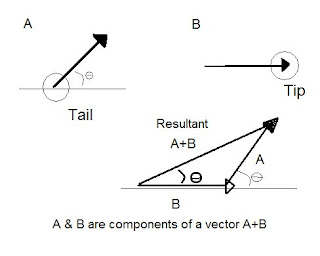
And for the people that was away, dont forget to hand in the "appendix 3.8: inter pretending position time graph which was due today. and we also received 3 sheets called "section 4.2: components of vectors, Simple Vectors, and a crossword puzzle. so dont forget to pick those up.
THE NEXT SCRIBE : ALDRIN SAYUNO
Section 5.1: Graphing Motion in One Dimension
- Position(y-axis) Time(x-axis)
- At the same position
- Objects at rest
- Not a finite period of time
- 0's
- A
- D
- B
- B
- D
- C
- arrows going to the right that are the same distance apart
- two dots separated from each other
- arrows going to the left that are the same distance apart
- False (4 quantities)
- True
- False (d represents the the position at any time)
- True
- True
Segment v a - 0.25km/min
v b - 0
v c - 0.4km/min
Δt a - 10min
Δt b - 7min
Δt c - 13min
Δd a - 2.5km
Δd b - o
Δd c - 5.2km
Table Two
Δt = 30min
distance ran = 7.7 km
displacement = 17.7
average velocity = 0.26 km/min
Section 4.1: Properties of Vectors
- 6km (E)
- 6km (N)
- 6km (NW)
- 4km (N)
- 3km (W)
- 5km (SE)
- 4m (SW)
- 12km (E)
- 20m (SE)
- 400m (W)
- b) d=2.0 km north
- d) d=2.0 km
- H,F,B
- B,F,G,I
- B,F
- True
- False (protractor)
- False (tail)
- True
- False
Ms. Kozoriz also taught us something about adding vectors. Here it is if you guys missed it

And for the people that was away, dont forget to hand in the "appendix 3.8: inter pretending position time graph which was due today. and we also received 3 sheets called "section 4.2: components of vectors, Simple Vectors, and a crossword puzzle. so dont forget to pick those up.
THE NEXT SCRIBE : ALDRIN SAYUNO
Wednesday, November 19, 2008
November 19, 2008
Kinematics!
Today in class, we had a substitute filling in for Ms. Kozoriz and corrected the chapter 3 study guide. I'll post the answers up just in case anyone missed any blanks.
Position and Distance
An object's position can be described in terms of its relationship to a reference point. Choosing a reference point establishes a(n) frame of reference. Describing distance does not need a(n) frame reference. Distance involves only a measurement of length, and is a(n) scalar quantity. Position involves both distance and direction, and is a(n) vector quantity.
Average Velocity
If an object is moving, its position at one and only one time is a(n) instantaneous position. The change is position of an object is its displacement, which is a(n) vector quantity. The average velocity of an object is the change in position divide by the time interval over which the change occurred. Average velocity is calculated using the equation v=Δd/ Δt. In this equation Δd, which is read as "delta d", stands for displacement. the symbol Δt, which is read as "delta t", stands for time interval. Average velocity is expressed in a unit made up of a(n) distance unit divided by a(n) time unit. Different units used to describe average velocity can be change can be changed from one to another by the use of conversion factors.
Finding Displacement from Velocity and Time
Displacement can be caculated by using the equation Δd= v Δt. In this equation, v represents average velocity and Δt represents the time intercal. if the average velocity of an object is the same at all time intervals, the object is described as moving at constant, or uniform, velocity. Constant velocity can be calculated using the equation v=d/t.
Position-Time Graphs
A position-time graph is used to show how position depends on time. If the motion is constant, the data produced a(n) straight line, which means the relationship between time and position is linear.
The Slope of a Position-Time Graph
On a position-time graph, the displacement is the vertical separation of two points. The time interval is the horizontal separation. the slop of the ratio of the rise to the run. The rise of the line represents displacement. The run of the line represents the time interval. the slope of the line represents the velocity of the object.
Positive and Negative Velocities
Displacements can be positive or negative, but time interval are always positive. Displacements to the right or the reference point are positive. Displacements to the left of the reference point are negative. Speed is the magnitude of velocity. Speed is generally shown as positive, but velocity can be positive or negative.
Instantaneous Velocity
If motion is not constant, the position-time grpah does not produce a(n) straight line. A straight line can be drawn tangent to the curve at any one point. The slope of this line is the instantanrous velocity at that point.
Velocity-Time Graphs
In a velocity-time graph, time is shown on the horizontal axis and velocity is shown on the vertical axis. If velocity is constant, the velocity-time graph produces a(n) straight line that is parallel to the horizontal axis. If velocity is incresing, the line has a(n) positive slope. If velocity is decreasing, the line has a(n) negative slope. The vertical value of any point on the line is the instaneous velocity at that time. The area under the line on a velocity-time graph is equal to the displacement of the object from its orignal position to its position at a given time.
Relativity of Velocity
Measurements of position of velocity depend on the observer's frame of reference. If a person walks slowly toward the back of a moving train, an observer on the train would say that the velocity and displacement are negative. A observer standing on the station platform would say that the walkers velocity and displacement are positive. Howerever, when velocities approach the speed of light, the frame of reference does not matter, and the velocity is the same, This concept is part of Einstein's theory of relativity.
We were also given time to do other worksheets (chapter 4 study guide and section 4.1: properties of vectors)
Kinematics!
Today in class, we had a substitute filling in for Ms. Kozoriz and corrected the chapter 3 study guide. I'll post the answers up just in case anyone missed any blanks.
Position and Distance
An object's position can be described in terms of its relationship to a reference point. Choosing a reference point establishes a(n) frame of reference. Describing distance does not need a(n) frame reference. Distance involves only a measurement of length, and is a(n) scalar quantity. Position involves both distance and direction, and is a(n) vector quantity.
Average Velocity
If an object is moving, its position at one and only one time is a(n) instantaneous position. The change is position of an object is its displacement, which is a(n) vector quantity. The average velocity of an object is the change in position divide by the time interval over which the change occurred. Average velocity is calculated using the equation v=Δd/ Δt. In this equation Δd, which is read as "delta d", stands for displacement. the symbol Δt, which is read as "delta t", stands for time interval. Average velocity is expressed in a unit made up of a(n) distance unit divided by a(n) time unit. Different units used to describe average velocity can be change can be changed from one to another by the use of conversion factors.
Finding Displacement from Velocity and Time
Displacement can be caculated by using the equation Δd= v Δt. In this equation, v represents average velocity and Δt represents the time intercal. if the average velocity of an object is the same at all time intervals, the object is described as moving at constant, or uniform, velocity. Constant velocity can be calculated using the equation v=d/t.
Position-Time Graphs
A position-time graph is used to show how position depends on time. If the motion is constant, the data produced a(n) straight line, which means the relationship between time and position is linear.
The Slope of a Position-Time Graph
On a position-time graph, the displacement is the vertical separation of two points. The time interval is the horizontal separation. the slop of the ratio of the rise to the run. The rise of the line represents displacement. The run of the line represents the time interval. the slope of the line represents the velocity of the object.
Positive and Negative Velocities
Displacements can be positive or negative, but time interval are always positive. Displacements to the right or the reference point are positive. Displacements to the left of the reference point are negative. Speed is the magnitude of velocity. Speed is generally shown as positive, but velocity can be positive or negative.
Instantaneous Velocity
If motion is not constant, the position-time grpah does not produce a(n) straight line. A straight line can be drawn tangent to the curve at any one point. The slope of this line is the instantanrous velocity at that point.
Velocity-Time Graphs
In a velocity-time graph, time is shown on the horizontal axis and velocity is shown on the vertical axis. If velocity is constant, the velocity-time graph produces a(n) straight line that is parallel to the horizontal axis. If velocity is incresing, the line has a(n) positive slope. If velocity is decreasing, the line has a(n) negative slope. The vertical value of any point on the line is the instaneous velocity at that time. The area under the line on a velocity-time graph is equal to the displacement of the object from its orignal position to its position at a given time.
Relativity of Velocity
Measurements of position of velocity depend on the observer's frame of reference. If a person walks slowly toward the back of a moving train, an observer on the train would say that the velocity and displacement are negative. A observer standing on the station platform would say that the walkers velocity and displacement are positive. Howerever, when velocities approach the speed of light, the frame of reference does not matter, and the velocity is the same, This concept is part of Einstein's theory of relativity.
We were also given time to do other worksheets (chapter 4 study guide and section 4.1: properties of vectors)
Tuesday, November 18, 2008
Kinematics
Hello !
Today in class we did quite a bunch of things. One of which was correcting Appendix 3.6: Describing Motion in Various Ways
Appendix 3.6: Describing Motion in Various Ways:
I'm pretty sure that people made some minor mistakes because of the "ohhh!" reactions and "that's how it is!" responses after Mrs. K told us the answers. I think the tricky part of the whole thing was the l ast two questions. (Question 4 letters e and f)
e) What is the total displacement for the student's journey? Find this from the graph.
I'm pretty sure most of got the right numeric answer (5m) but must of us missed the minor things that makes all the difference. First of all, this one needs a direction [south] and since it's going in the southerly direction, it is negative. Therefore you can either put your answer in the form 5m [south] OR -5m to show the negative.
f) What is the average velocity for the whole journey?
Average velocity can be calculated using the formula v = d/t
The tricky part of this question is the same as the last question. Basically the possible minor errors that can occur can lose you a mark!
answer: .1 m/s [s] OR -.1 m/s
--
Aside from correcting the worksheet, Mrs. Kozoriz left us with other work to do. Those are all for homework (Position-Time Graphs, Chapter 3 Study Guide and Study Guide 5.1 Graphing Motion in One Dimension)
OUR NEXT SCRIBE IS:: LYNEL POBRE!
Subscribe to:
Posts (Atom)
