Hello everybody. This shall possibly be my last official scribe post for this blog. In addition, today is a big day. It is the day that marks the intervention of having a one month anniversary of blogging absences for this blog. It is also the day that precedes our Gravitational-Electric Fields Test. Good luck to everyone on that. As for what happened today in class, we went through a couple of worksheets and problems. Here is a concise summation of the essential bits gone through below.
We wholly went through Gravitation Fields Review - Worksheet. There exists three sample questions with answers at the very bottom of the last page. Be sure to check that out.
We went through Chapter 2: Motion - Exercise 2-1. Answers are as follows:
1. Greyhound speed=16m/s, Gazelle time=0.01s, and Turtle distance=30cm.
2. a) The BB is gaining distance and speed in each successive time interval.
b) Yes, distance is directly proportional to T^2 (time squared)
c) Distance Fallen: 1, 4, 9
d) Yes; 9cm, 11cm, 13cm. Distance Fallen: 1, 3, 5, 7
e) odd
3. a) 10, acceleration
b) time
c) 70m/s, 245, 10
Green Textbook Questions *forgot pages*
1) 20000 N/C
2) 7 x 10^-5 C
3) 4.44 x 10^-7 C
17. a) 1.6 x 10^-18 C
b) N = 10 electrons
In pre-conclusion, we received Chapter 24: Study Guide - 24.1 Magnets: Permanent and Temporary, The Earth's Magnetic Field, and 1.3 Magnetic Poles worksheets. Oh yeah, people need to scribe. I initially was just going to let the next scribe be anyone that needed to scribe, but seeing as how I took initiative after so many days, I shall choose a person so that they are obligated to scribe. Well hopefully they commit. Hmm. Roses are red, violets are blue, no available scribe name rhymes with blue, so Lynel I choose you :P
Showing posts with label Archimedes. Show all posts
Showing posts with label Archimedes. Show all posts
Tuesday, January 13, 2009


Wednesday, December 10, 2008
Class on Wednesday, December 10, 2008
I'll revive this fairly deceased blog by re-initiating scribing. *cough* bonus marks *cough* I mean there is a test tomorrow on the unit, dynamics - a branch of mechanics that deals with forces and their relations to patterns of motion. I posted the sheet consisting of anagrams because it was from the past and no one was blogging for quite a while. Okay, so euphemistically, there is a lovely and highly admired test tomorrow. Good luck to everyone. There is an immaculate review below as posted by our teacher to remedy any difficulties that one may stumble upon while writing the test. Below are sheets I scanned, so feel free to browse.


remember that there is no air resistance when a rock is in free fall. that was my first instinct but then i asked for the opinions of others


for 8b) Ms. K said the answer being force RESISTING the car's motion was 3740N, but I still object. The force of the car caused by acceleration is 3740N as calculated by multiplying the mass and acceleration. To further justify, it states that the force put on the wheels due to the road is 5600N, which is a frictional force and what we are trying to find is the resisting force being the force impeding the car. So I obtain the difference between the two resultant forces which results in 1860 N [East]. Friction resists, so this is the resisting force.

We went through the sheets above and received back our assignment on vectors. Well this is a fairly accurate summation of class today. I dub the next scribe Sir Dion Palumbo. He's a lucky duck to be the scribe for the day of the test. Thou shall scribe effortlessly because of the sympathetic initiator.
Tuesday, November 4, 2008
Physics Class of November 4, 2008
Ohh obligatory blogging, thou art a piercing blow to the heart that effortlessly causes one to cease his/her endeavours in academics -_- Today was the first Tuesday of the month, so common sense dictates that it was a half day.
To succinctly summate our activities in class, we worked on a chart for the "Wave Theory of Light" labelled Appendix 2.4: Chart for Evaluating the Models of Light. From here, we were tasked to define supporting and counter arguments that dealt with the given "phenomena." This task was very self-evident. After that, we were to do questions 9, 10, 11 and 12 of the "The Nature of Light: Part 2 The Wave and Particle Models of Light Problems" booklet.

And as well, the "BLM 2.10 : Contributions to the Determination of the Speed of Light" paper was to be handed in. This was the sheet where we were to entitled to choose a certain contributor to write about. From there, we were to fill out the chart.
To succinctly summate our activities in class, we worked on a chart for the "Wave Theory of Light" labelled Appendix 2.4: Chart for Evaluating the Models of Light. From here, we were tasked to define supporting and counter arguments that dealt with the given "phenomena." This task was very self-evident. After that, we were to do questions 9, 10, 11 and 12 of the "The Nature of Light: Part 2 The Wave and Particle Models of Light Problems" booklet.
Here are the solutions predicated on my answers.
9) refer to that golden yet vague visual representation below

10) refer to that golden yet "inaccurate" image up above
11a) The wave theory says that the wavelength and speed both decrease for frequency remains the same despite the change in mediums. In this case, the mediums were from deep water to shallow water. Read this my fellow minions and acquaintances (just joking), light is slower in SHALLOW water as opposed to light DEEP water. Based on that, one can easily conclude that the wavelength and speed is lower in shallow water.
b) The Wave Theory suggests light moves slower in denser mediums while the Corpuscular Theory suggests light moves faster in denser mediums.
12) Mighty small !
And as well, the "BLM 2.10 : Contributions to the Determination of the Speed of Light" paper was to be handed in. This was the sheet where we were to entitled to choose a certain contributor to write about. From there, we were to fill out the chart.
Test Next Week Too ! Goodbye !
i choose you.... caaamy....
Tuesday, September 9, 2008
September 9, 2008
Archimedes here, replacing Dion as our first scribe after agreeing that he allow me to be the first scribe of our class in exchange for appointing a classmate of his choice to be the next scribe. In case you are wondering who I am, I'm a Greek physicist, mathematician and astronomer. Well, I was at least... or I'm just Aldrin..
Today was a continuation of last Friday where we were ungracefully interrupted by a long, yet brief assembly. We were to obtain a blue "Grade 11 Physics Waves in One Dimension" booklet if we had not already acquired one on Friday. We read the first few pages of the booklet and later proceeded to going on our field or hall trip. We also received four sheets to complete, which are as follows:
Today was a continuation of last Friday where we were ungracefully interrupted by a long, yet brief assembly. We were to obtain a blue "Grade 11 Physics Waves in One Dimension" booklet if we had not already acquired one on Friday. We read the first few pages of the booklet and later proceeded to going on our field or hall trip. We also received four sheets to complete, which are as follows:
Grade 11 Physics: Waves in One Dimension
Physics 11 Period & Frequency Problems
Concept-Development Practice Page: Vibrations and Waves 25-1
Characteristics of Waves: Physics 30S
Here is a general overview of what we discussed and did in class.
Archimedes’ Language Bank (Terms and Definitions)
Archimedes’ Language Bank (Terms and Definitions)
Key Formulas
V= λ / T
V=f λ
F=1/T
V= λ / T
V=f λ
F=1/T
Continuous (Periodic) Wave: a wave produced by a disturbance (oscillating or vibrating source) that is moving back and forth continuously
-Producing a back and forth motion while holding onto a slinky creates a continuous wave
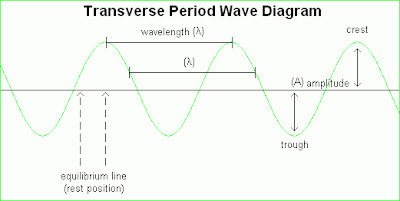
Transverse Wave: a continuous occurrence of pulses where the particles are simply displaced up and down while traveling in a direction that is perpendicular to the pulse itself
-Waves traveling on a guitar
Crest: the highest point on a wave
Trough: the lowest point on a wave
Amplitude (A): the distance between a crest or trough and equilibrium lin
Equilibrium Line (Level): the undisturbed position or axis of zero
Cycle: one complete sine wave or complete up and down motion, which is also known as one complete oscillation
Wavelength (λ): horizontal length of one cycle of a wave, or in other words, the horizontal distance between any two successive equivalent points on the wave. In a longitudinal wave, it is the horizontal distance between the center of a rarefaction and center of one next to it
Frequency (f): number of complete cycles or crests that pass a given point per unit of time, commonly measured in cycles per second or hertz (Hz)
Period (T): the time elapsed between two successive crests passing by the same point in space where the standard unit of period is the second
Wave Velocity (V): velocity at which the wave moves
Longitudinal Wave: the vibration of particles of the medium traveling the same direction as the motion of the wave
Compressions: areas in a longitudinal wave that are momentarily close together
Rarefactions (Expansions): regions where the coils are momentarily far apart
I apologize for my lack of effort I put into this scribe post. You may find a lot of grammatical, capitalization, punctuation, and spelling errors, but whatever. I needed to rush because I had other things to do. Anyways, good luck to the next scribe, who is Rebecca and slinky thingy tomorrow I believe?
Subscribe to:
Posts (Atom)

