Hola everyone! Tis Nicole here.
Super sorry this blog is late, I had to way of getting to a computer last night and I never expected to be in the Guidance this morning for a whole hour.
Okay, so yesterday in class what we did first was correct the worksheet Sound Waves and the questions 10, 14, 16, and 20 in the sound booklet.
The answers for the booklet questions are as follows:
10. a) 529-524= 5Hz
10. b) T= 1/f = 1/5 = 0.2s
14. 440Hz - 5Hz = 435Hz
440Hz + 5Hz = 445Hz ---this is the frequency
436Hz + 9Hz = 445Hz ---this is the frequency
436Hz - 9Hz = 427Hz
Seeing as I am getting kicked off our schools computers because of a class, I'll finish this HOPEFULLY at lunch, or else once I get home (all depending if my brother left his laptop at home).
UPDATE
Okay, I'm finally here to finish the scribe.
16. wavelength = velocity/frequency = 331m/s / 261.6Hz = 1.27m
length = wavelength/4 = 1.27/4 = 0.316m
20. a) velocity = 331m/s + ((23'C)(0.6)) = 345m/s
b) 20m is full trip
10m/s is half the trip
d=vt=(345m/s)(1.0x10^-3s)=3.45m
Since I am in a major rush at the moment, I am just going to state the answers for the Sound Waves sheet:
1. 1218m
2. 8.77s
3. 1.19
4. 642m
5. 260m
We then read page 19, Musical Notes and Frequencies of Sound, where Ms K explained a triad, which is "a collection of three notes with frequencies in the ratio of 4:5:6", an example being the notes C, E, and G, which have frequencies of 256Hz, (5/4)(256)=320Hz, and (6/4)(256)=384Hz.
Ms K then demonstrated to us BoomWhackers, which are plastic tubes that when hit across your leg or something of that sort make a specific note, or produces a sound at a specific frequency.
We were given two sheets called "Singing Straws" where we made a an instrument that our of a straw by cutting holes into it and blowing through it.
The other sheet happened to be "Making A Straw Oboe" where we snipped one end of a straw so it looks like two reeds and we made a buzzing sound that depended on the length of the "reed" and how long the straw was.
There were questions to be answered in on these labs as well.
Oh, and a few people played Jingle Bells with the BoomWhackers. Whoever took the video should definitely upload it onto here.
The next scribe is Ryan, which should have been Melissa but I didn' realize that there was someone left who hadn't scribed yet so hopefully he picks her.
We'll see.
Showing posts with label sound. Show all posts
Showing posts with label sound. Show all posts
Thursday, October 16, 2008


Wednesday, October 15, 2008
Sound
Hello:-)
Today, we watched a video about:
-Temperature, Material and Speed of Sound
-Doppler Effect on Sound
- Sound Barrier/Bending
and to jot down 10 interesting things about it.
Sound Test on Friday, 17th of October.
Nicolias to scribe for tomorrow!
Today, we watched a video about:
-Temperature, Material and Speed of Sound
-Doppler Effect on Sound
- Sound Barrier/Bending
and to jot down 10 interesting things about it.
Sound Test on Friday, 17th of October.
Nicolias to scribe for tomorrow!
Thursday, October 9, 2008
Wednesday, October 8, 2008
Oct. 8, 2008
Hello everybody!! it's me Ramina and I'm the scribe for today's class.
Today we did our labs about the Speed of Sound. In this lab we examined the differences between ice water and hot water.
First of all we measure the temperature of each water, then strike the tuning fork hard and soft, while striking it we examined the differences between loudness and softness of the sound such as the wavelength, speed, and the length of the sound.
Here is the lab worksheet that we just did, in case you need it..

I'm sorry if it's lack of info. :)
Ahmm,,
also reminder...
don't forget to finish the worksheets about sound that we got from ms. K :)
we will be checking it tomorrow...
next scribe is.... KIM
Today we did our labs about the Speed of Sound. In this lab we examined the differences between ice water and hot water.
First of all we measure the temperature of each water, then strike the tuning fork hard and soft, while striking it we examined the differences between loudness and softness of the sound such as the wavelength, speed, and the length of the sound.
Here is the lab worksheet that we just did, in case you need it..

I'm sorry if it's lack of info. :)
Ahmm,,
also reminder...
don't forget to finish the worksheets about sound that we got from ms. K :)
we will be checking it tomorrow...
next scribe is.... KIM
Tuesday, October 7, 2008
Tuesday
Hi! I'm Larlyn your scribe for today's class... anyways..
Ms. Kozoriz go over the Vocabulary Review here's the answer....
1. Amplitude
2. Frequency
3. Interference
4. Wavelength
5. Standing Wave
6. Sound Level
7. Open-pipe resonator
8. Octave
9. Resonance
10. Consonance
11. Loudness
12. Dissonance
13. Timbre
14. Doopler Shift
15. Closed-pipe resonator
16. Fundamental
17. Beat
18. Pitch
19. Harmonics
20. Echoes
21. Decibels
And then she said that were having lab tomorrow. She read the yellow booklet we have, starts on page 6-9
Standing Wave Patterns in Longitudinal Waves
In our study of waves in an earlier module, we observed that a standing wave pattern is formed when reflected waves interfere with incidence waves to form a "standing wave" that appears to be standing in place. We learned that the frequency at which the standing wave exists is called the resonant frequency. Each resonance frequency is a whole-number multiple of the lowest resonance frequency called the fundamental frequency.
Sound waves are longitudinal waves, so to understand standing waves in sound let us look again at the Slinky. When the longitudinal waves reflect from a wall, the forward and backwad waves can produce a stading wave. As in a transeverse wave, there are nodes and atinodes. At the nodes the coils of the Slinky do not vibrate at all, that is they do not have any displacement. At the antinodes the coils vibrate with maximum amplitude. This is indicate by the dots with the arrows indicating back and forth movement. At an antinode, the coils have maximum displacement. The vibration occurs along the line of travel of the individual waves. In a standing wave, the molecules and atoms of the medium behave as the dots in the diagram below.
there's the diagram below your booklet.
next she read is about
Standing Waces: Tube open at Both Ends
Musical instruments in the wind family depend on longitudinal standing waves to produce sound. Wind instruments like the trumpet, flute, clarinet, pipe organ, and so are modified columns of air. Sound waves that originate at one end of the tube travel up and down each tube. This is possible because the sound waves reflect from both ends of the tube even though the ends are open. If the frequency of the tuning fork matches one of the natural frquencies of the air column, the downward and upward travelling waves combine to form a standing wave, and the sound of the tuning fork becaomes even louder.
The diagram below the page compare the standing waves in a Slinky on the left with the air pressure patterns on the right. The patterns on the right symbolize the amplitude of the vibrating air molecules at various locations. Where the pattern is widest, the amplitude of the vibration is the greatest. Whenever the pattern is narrow, there is no vibration. In both examples there is a displacement antinode at each end of the tube because air molecules there are free to move. As in the transverse wave the distance between two antinodes is one-half of a wavelength, so the length L of the tube must be an interger number n of half-wavelengths:
Some Formulas and Diagram
Read:
Standing Waves: Tube Open at One End
Measuring the Speed of Sound
Those two are our lab for tomorrow. She also gave us three sheets to work on:
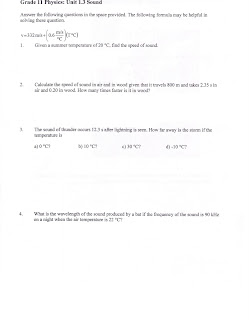
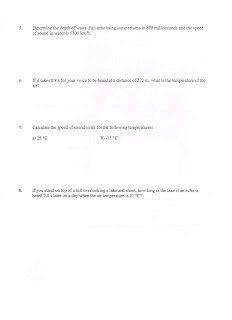

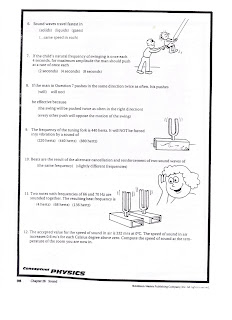
Next Scribe...RAMINA!!!!^_^
Monday, October 6, 2008
Sound Stuff
Hello guys! Suzette here, scribing... duhh? Well anyway, today, what we did was go over the test that we wrote last week: Waves in Two Dimensions. I hope you guys are satisfied with your mark 'cause I am, haha. Then after that we went over the yellow booklet and learned more about sound waves... o.o
Here are some facts according to the booklet:
Natural Frequencies and Resonance
Natural Frequency is when an object is allowed to vibrate freely at a specific frequency.
- depends on the size, shape, and composition of the object.
Resonance is the condition in which force is applied to an oscillator at the point of maximum amplitude.
- is a matter of one object "getting in tune" with another object.
The Fundamental Frequency
* A standing wave can only be created in a medium of fixed length at certain frequencies. This wave can exist only at a resonant or natural frequency.
Vibrating objects that have only a single resonant frequency:
- tuning fork
- pendulum
- mass bouncing on a spring
Vibrating objects that have many resonant frequencies:
- rope
- stretched spring
- air in an air column (used in musical instruments)
Fundamental Frequency, fo is the lowest frequency at which a system vibrates freely (standing waves).
Harmonics - the resonant frequencies of standing waves.
Fundamental frequency = first harmonic
Beats and Beat Frequency
So, what happens when sound waves have slightly different frequencies?
Well....
Let say you have two tuning forks with the frequency of 440 and 438. When you strike these forks, it creates a sound that rises and falls periodically so that it is faint, then loud, then faint again, then loud again, and you get the idea. These vibrations in loudness are known as beats. They are produced by the interference of sound waves with slightly different frequencies.
Beat frequency
- is the number of times that the loudness rises and falls every second.
- is the difference between two sound frequencies.
- based on the tuning forks above: 438 Hz - 440 Hz = 2 Hz
- 2 Hz is the beat frequency.
And that is all about the yellow booklet...
Moving on....
The next thing we did was watch a video about Beats of Sounds (it's the teacher guy who draws awesome straight lines) =)
The video is basically about you know, sounds.
The only thing I remembered is, when you have a water wave and then you add another wave, it produces NOTHING. And it's the same thing for the sound waves, they produce basically nothing. <<<<---- err... this, I'm not really sure. The video is so interesting I didn't even bother to write anything about it. However, if you know or have something to say, just say it so I can, maybe, fix it.
OKay, in addition...
the last thing we did was work on the Vocabulary Review sheet.
The End.
P.S. Sorry for the lack of effort (no illustrations at all).
---------
The NEXT SCRIBE is LARLYN!
Here are some facts according to the booklet:
Natural Frequencies and Resonance
Natural Frequency is when an object is allowed to vibrate freely at a specific frequency.
- depends on the size, shape, and composition of the object.
Resonance is the condition in which force is applied to an oscillator at the point of maximum amplitude.
- is a matter of one object "getting in tune" with another object.
The Fundamental Frequency
* A standing wave can only be created in a medium of fixed length at certain frequencies. This wave can exist only at a resonant or natural frequency.
Vibrating objects that have only a single resonant frequency:
- tuning fork
- pendulum
- mass bouncing on a spring
Vibrating objects that have many resonant frequencies:
- rope
- stretched spring
- air in an air column (used in musical instruments)
Fundamental Frequency, fo is the lowest frequency at which a system vibrates freely (standing waves).
Harmonics - the resonant frequencies of standing waves.
Fundamental frequency = first harmonic
Beats and Beat Frequency
So, what happens when sound waves have slightly different frequencies?
Well....
Let say you have two tuning forks with the frequency of 440 and 438. When you strike these forks, it creates a sound that rises and falls periodically so that it is faint, then loud, then faint again, then loud again, and you get the idea. These vibrations in loudness are known as beats. They are produced by the interference of sound waves with slightly different frequencies.
Beat frequency
- is the number of times that the loudness rises and falls every second.
- is the difference between two sound frequencies.
- based on the tuning forks above: 438 Hz - 440 Hz = 2 Hz
- 2 Hz is the beat frequency.
And that is all about the yellow booklet...
Moving on....
The next thing we did was watch a video about Beats of Sounds (it's the teacher guy who draws awesome straight lines) =)
The video is basically about you know, sounds.
The only thing I remembered is, when you have a water wave and then you add another wave, it produces NOTHING. And it's the same thing for the sound waves, they produce basically nothing. <<<<---- err... this, I'm not really sure. The video is so interesting I didn't even bother to write anything about it. However, if you know or have something to say, just say it so I can, maybe, fix it.
OKay, in addition...
the last thing we did was work on the Vocabulary Review sheet.
The End.
P.S. Sorry for the lack of effort (no illustrations at all).
---------
The NEXT SCRIBE is LARLYN!
Friday, October 3, 2008
Friday, October 3rd
Hey people, as you all know we had a test yesterday and i hope everyone did very well.
Today in class we did three labs with sound waves. The first one was using a ruler. In this lab you had to hold a ruler on the side of the desk and push it down and let it go so it makes a sound, producing sond waves. The second lab we did used a beaker of water and a plastic cylinder. In this lab you had to blow into the cylinder without water in it and listen to the sound, then you had to pour some water in and listen for a change in sound, finally you had to blow across the top of the tube while pouring water into the tube and explaine what you heard. Ther third lab was the most fun, in my opinion anyways. In this lab we got to use the tuning forks. We got to see how different size tuning forks with different frequencies made different sounds. The last thing we did in class, before we had the first of two fire drills in one day, was a vocabulary work sheet.
Well thats what we did in class today. Hope everyone has an amazing weekend.
Mondays scribe is going to be......umm lets see.. hmm... i pick.... Suzettes. :D Once again have a fabulous weekend!!!!!!!!!!!
Subscribe to:
Posts (Atom)
